Agriculture Minister, Hon. Zulfikar Mustapha, recently attended the inauguration ceremony marking the assumption of office of Dr. Muhammad Ibrahim as Director General of the Inter-American Institute for Cooperation on Agriculture (IICA).
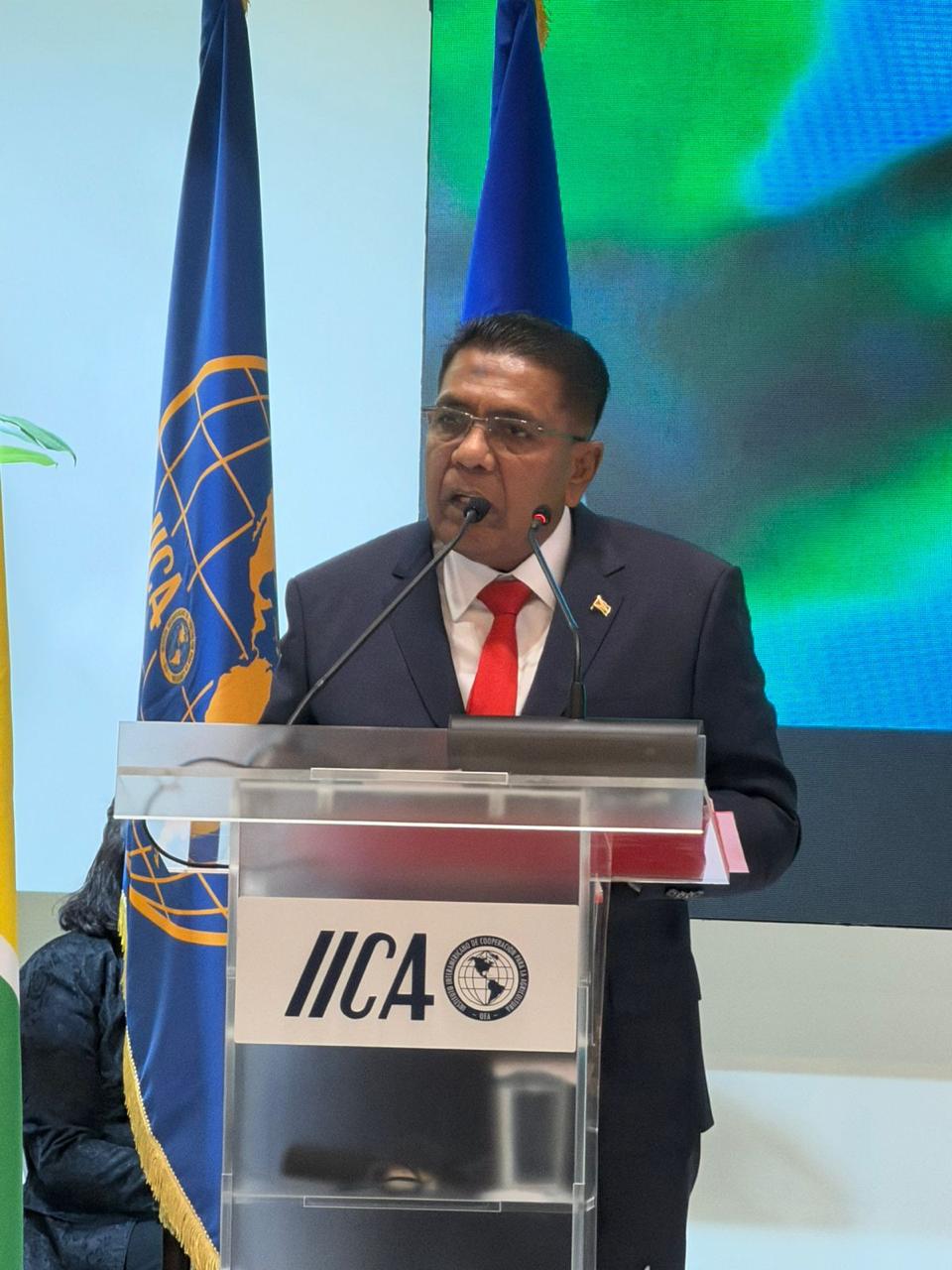
The high-level ceremony brought together senior government officials and representatives from more than thirty countries across the Americas.
While delivering remarks during the ceremony, Minister Mustapha emphasized that the most pressing challenges confronting agriculture across the region, such as climate volatility and food import dependency, require collective, coordinated responses.
“The challenges before us—climate volatility, food import dependency, and the digital divide—are regional in nature, and so too must be our solutions. This is where IICA’s unique value is most clearly demonstrated: as the trusted technical partner that transforms regional policy into tangible, on-the-ground impact across all 34 Member States,” the Minister said.
He highlighted Guyana’s ongoing investments in digital agriculture and their relevance to regional integration, noting that national initiatives are being designed with scalability and shared regional benefit in mind.
“Guyana’s initiative to establish a Real-Time Agriculture Situation Room is a national project, but its true power lies in its potential as a node within a future CARICOM-wide digital ecosystem. Similarly, our collaboration on the ‘Farming in the Palm’ application and the planned Centre of Excellence for Agricultural Studies are conceived not as isolated ventures, but as strategic contributions to a shared regional architecture of innovation,” Minister Mustapha explained.
Looking ahead, Minister Mustapha acknowledged that IICA itself must continue to evolve to remain responsive to emerging priorities and an increasingly complex global environment.

“Under your leadership, Dr. Ibrahim, the reorganization and strengthening of the institution will be essential to ensuring that it remains agile, responsive, and fit for purpose. Aligning internal structures with priorities such as digital agriculture, climate-smart production, investment facilitation, and regional health security will be key to sustaining IICA’s relevance and effectiveness,” he stated.
Minister Mustapha also outlined CARICOM’s priorities as guided by decisions of the Council for Trade and Economic Development (COTED), highlighting IICA’s central role in advancing these objectives. He noted that COTED has agreed to fully operationalize the Regional Electronic Marketing Information System, a tool developed with IICA’s support to improve market transparency, connect buyers and sellers, and advance the region’s 25 by 2025 + 5 food security target.
“This system is critical to dismantling information barriers and making regional trade a practical reality. We look with confidence to IICA to intensify its efforts in building the cooperation and partnerships required to generate the data and intelligence needed to guide our trade ventures, while embracing each country’s comparative advantages,” the Minister said.
While addressing regional food safety and market access, Minister Mustapha emphasized the economic importance of strengthening the region’s influence in international standards-setting.
“COTED has endorsed the Codex Alimentarius Awareness and Capacity-Building Initiative championed by IICA. Strengthening our region’s voice in shaping international food safety standards is not a technical nicety; it is an economic imperative to protect consumers and secure export markets,” he noted.
He further highlighted regional health security as a shared priority, referencing IICA’s leadership in strengthening preparedness against transboundary animal diseases.
“The threat of diseases such as African Swine Fever respects no borders. IICA’s work in fostering regional coordination, harmonizing protocols, and strengthening laboratory readiness exemplifies the One Health approach—safeguarding livelihoods, food supplies, and public health across our Community,” Minister Mustapha said.
Minister Mustapha outlined CARICOM’s expectations for IICA’s leadership during what he described as a decisive decade for the region. He called for accelerated digitalisation through integrated regional systems, the scaling of climate-smart agriculture, such as innovations including GUYIICA-17 biofortified rice, the strengthening of harmonized standards and resilient value chains, inclusive growth that benefits smallholders, women, and youth, enhanced regional health security, and a renewed focus on nutrition and human capital to ensure improved health outcomes.