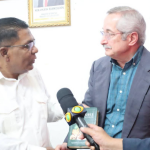
The Inter-American Institute for Cooperation on Agriculture hosted a roundtable for its AgriConnect Initiative for Latin America and the Caribbean (LARC) at its headquarters in Washington, DC on Friday. The event brought together Ministers of Agriculture and other senior officials from across Latin America and the Caribbean.
AgriConnect is a World Bank Group initiative designed to expand rural connectivity, promote digital inclusion, and integrate family farmers into markets. The initiative aims to support up to 300 million smallholder farmers worldwide by 2030 by strengthening access to technologies, financing, knowledge, and digital tools. It also seeks to improve producers’ incomes, generate jobs throughout agri-food value chains, and enhance food security, contributing to more inclusive and sustainable rural development.

During his presentation, Agriculture Minister, Hon. Zulfikar Mustapha, said Guyana is moving in a direction that focuses on building the right food ecosystem—one with strong small-scale farmers, improved market linkages, and better access to finance and digital tools.
“Guyana’s agriculture sector is transitioning from traditional practices to a modern, climate-smart, and data-driven industry. Our initiatives are designed to reduce production costs and enhance household incomes, demonstrating our commitment to progress. AgriConnect’s emphasis on investments in physical infrastructure, natural resources, human capital, digital solutions, training, extension services, and research mirrors Guyana’s national agenda. We are prioritizing modern drainage and irrigation systems, expanding farm-to-market roads, upgrading storage and cold chain systems, and building a digitally enabled extension service,” he explained.
Minister Mustapha also noted that the initiative calls for country-level commitments to improve opportunities for farmers and agribusinesses, as well as policy reforms to unlock investment in the agri-food sector.
“Guyana has been aggressively pursuing such reforms, including the implementation of a successful crop insurance framework in the rice sector and climate-smart agriculture initiatives such as shade houses, tunnel ventilation pens, and improved crop varieties. These have already begun to positively impact our farmers and their livelihoods,” he added.
Furthermore, Minister Mustapha told officials that there are several areas where AgriConnect can accelerate the transformation of Guyana’s agriculture sector.
“The Guyana Development Bank, slated for 2026, will provide farmers and small businesses with easier access to credit to expand their operations and invest in new production technologies. AgriConnect can help strengthen the financial ecosystem for farmers, turning agriculture from a survival activity into a bankable, investable, and profitable enterprise. Guyana is investing in mega food parks, modern port facilities, cold storage, and a regional food hub. These investments position us to contribute meaningfully to Caribbean Community’s regional agenda of reducing the region’s food import bill by 25% by 2030. AgriConnect can assist in harmonizing standards, improving traceability, and expanding export readiness. Additionally, Guyana is advancing an Agriculture Information System and a Farmers Connect mobile application that provides timely updates and technical information. AgriConnect can further support this through AgriTech solutions such as digital advisory services, digital public infrastructure, and production-focused technologies,” Minister Mustapha explained.
In addition to expanding access to markets and technologies, the programme also seeks to create economic opportunities in rural areas, particularly for young people, by encouraging them to remain in the countryside through more innovative and productive activities linked to global value chains.
The AgriConnect Initiative has an estimated global funding requirement of US$9 billion per year, with the potential to mobilize an additional US$5 billion in investments, strengthening innovation, financing, and agriculture-oriented service ecosystems.