- as Caribbean advances efforts to cut its food import bill
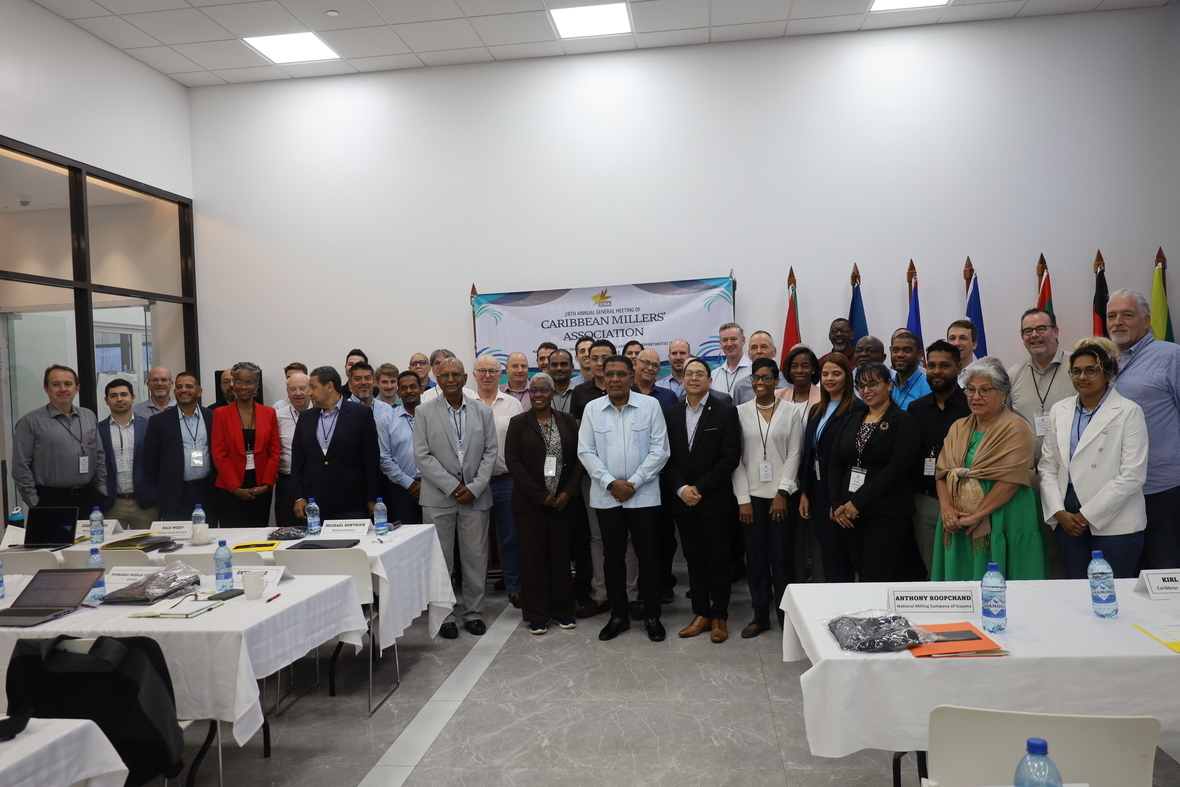
On Tuesday, Agriculture Minister, Hon. Zulfikar Mustapha, delivered the keynote address at the 28th General Annual Meeting of the Caribbean Miller’s Association. The high-level gathering brought together representatives from seventeen flour mills and twenty-one associate members across the Caribbean, North America, and other parts of the world, who play a vital role in food security, manufacturing, and economic growth across our region.

This year’s theme, “Navigating Global Shifts: Inflation, Tariffs, and Market Opportunities in a Changing World”, captures the central challenges and emerging opportunities faced in the region.
In his address, Minister Mustapha noted that inflationary pressures, climate extremes, supply chain disruptions, volatile commodity markets, and geopolitical instability increasingly shape the cost of a loaf of bread, the availability of grain, and the competitiveness of our regional industries.
He also acknowledged that millers occupy a critical point in the region’s food value chain, noting that every external disruption has direct implications for household food prices.
“For the Caribbean, rising tariffs, logistical delays, currency fluctuations, and unpredictable commodity prices directly affect farmers, processors, consumers, and, critically, you, the millers. Every shock upstream becomes a ripple that raises prices at home, often impacting the most vulnerable among us,” Minister Mustapha emphasized.
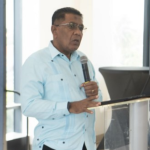
Calling on regional millers to embrace a stronger role in shaping market conditions, Minister Mustapha challenged them to move beyond traditional dependence on foreign suppliers.
“For decades, our region has been heavily dependent on external markets for grain. Every shock upstream becomes a ripple that raises prices at home, often impacting the most vulnerable among us. It is time for us to shift from being price-takers in global markets to becoming price-shapers in a more integrated and self-sufficient regional economy. It is within this context that Guyana continues to lead regional efforts aimed at reducing the Caribbean’s food import bill by 25% by 2025 +5. But we recognize that no country can achieve food security in isolation. The future of the Caribbean’s agri-food sector depends on strong, well-integrated value chains, from production to milling, distribution, and retail,” he explained.
The Minister also spoke about major ongoing investments to modernize Guyana’s milling industry and strengthen regional supply capacity.
“Guyana’s flour milling sector is itself undergoing significant modernization. The National Milling Company of Guyana (NAMILCO) is investing G$10 billion in a new processing mill, upgraded port and wharf infrastructure, and expanded wheat storage capacity. Importantly, NAMILCO and the Government are collaborating on the development of cassava flour, a strategic step toward diversifying supply chains, reducing import dependency, and supporting national and regional food security objectives. As we build capacity for alternative flours, Guyana is positioning itself as a supplier not only to domestic markets but to the wider Caribbean,” he noted.
Minister Mustapha also spoke about the development of cassava flour as a strategic alternative to imported wheat. He noted that the Government of Guyana and NAMILCO are advancing research, testing, and production to incorporate local starch into the national flour supply.
“As we build capacity for alternative flours, Guyana is positioning itself as a supplier not only to domestic markets but to the wider Caribbean. Even as global challenges intensify, new opportunities are emerging. Advances in energy-efficient machinery, grain storage, flour fortification, climate-smart agriculture, and sustainable packaging represent areas of tremendous potential for millers,” he explained.
Addressing the ongoing pressures of global inflation, the Minister underscored the need for efficiency, technology adoption, and better resource forecasting within the milling industry.
“Inflation remains one of the most persistent challenges affecting raw materials, shipping, and energy costs, and as a government, we are committed to creating more predictable and stable conditions to support investments in production and supply chains.
Minister Mustapha reiterated Guyana’s strong advocacy within CARICOM for the removal of outdated and burdensome trade barriers that constrain regional production and distribution.
“Through the CARICOM Ministerial Taskforce on Agriculture, we are addressing non-tariff barriers and outdated trade arrangements that limit regional sourcing and investment. strengthening regional trade will allow millers to source more efficiently, compete more effectively, and reduce vulnerability to global market shocks.” Minister Mustapha said.
The Minister also called for greater collaboration among millers, governments, and policymakers to ensure the Caribbean becomes more resilient and globally competitive.
“We stand at an important inflection point. The choices we make today will determine the food security of generations to come. let this meeting mark a renewed spirit of cooperation and strategic action. Together, we can build a Caribbean that is more self-reliant, more innovative, and more capable of shaping its own destiny,” minister Mustapha said.